
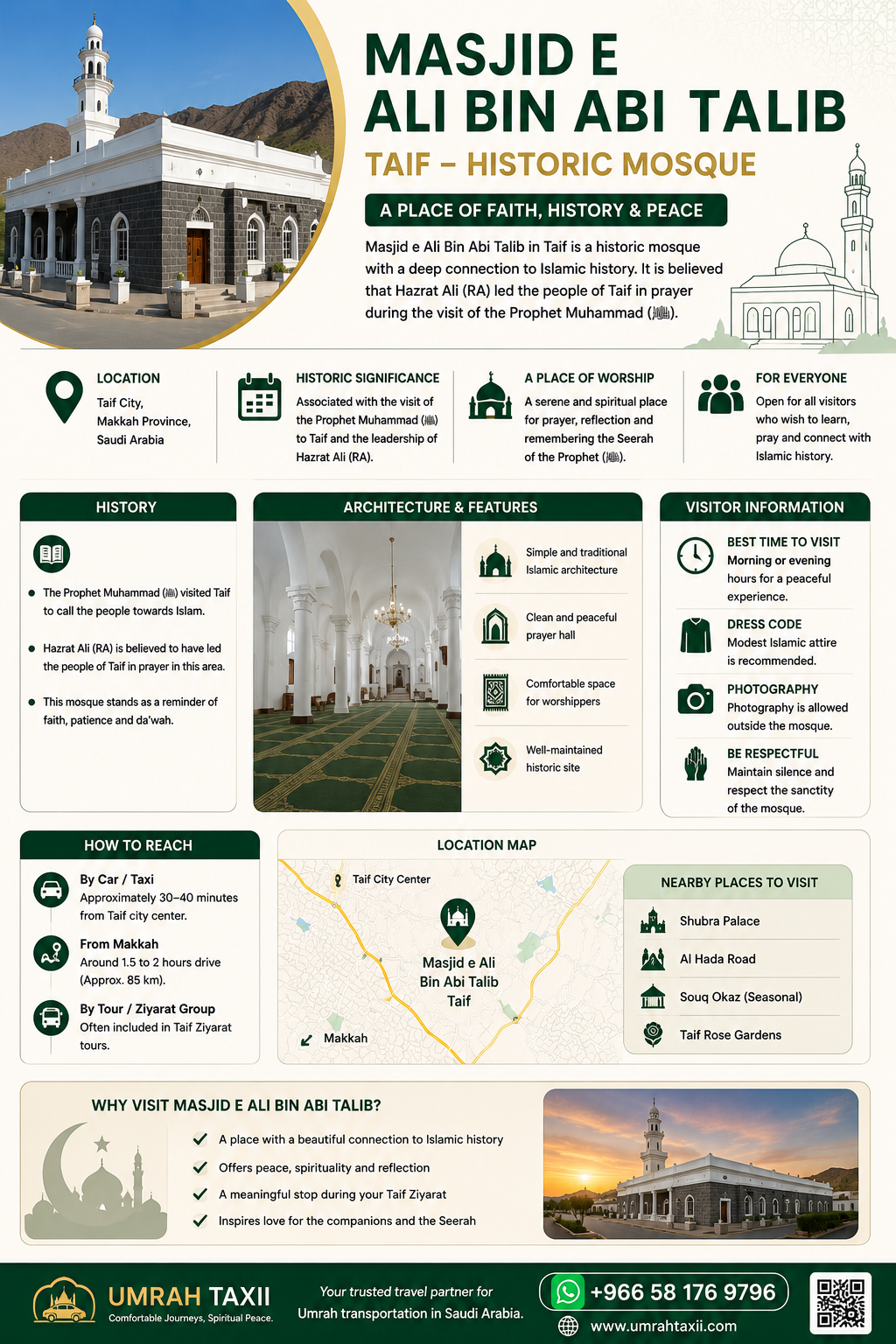
Masjid e Ali bin Abi Talib, Taif — History, Significance and Complete Visiting Guide
Among the many Islamic heritage sites scattered across the city of Taif in Saudi Arabia, Masjid e Ali bin Abi Talib holds a place of quiet but profound significance. It is not the largest mosque in Taif. It does not attract the enormous crowds of the Grand Mosque in Makkah or the Prophet’s Mosque in Madinah. But for the Muslim pilgrim or traveller who knows its history, stepping inside this small, well-kept mosque is one of the most spiritually meaningful moments a visit to Taif can offer.
This complete guide by Umrah Taxii covers everything you need to know about Masjid e Ali bin Abi Talib in Taif — who Ali ibn Abi Talib (RA) was, why this mosque was built in his honour, what makes it historically and spiritually significant, what you will find when you visit, and how to include it in your Taif Ziyarat itinerary.
Who Was Ali ibn Abi Talib (RA)?
Before understanding the mosque, it is essential to understand the man it commemorates — because Hazrat Ali ibn Abi Talib (RA) is one of the most significant figures in the entire history of Islam.
Ali ibn Abi Talib (RA) was born approximately ten years before the beginning of the Prophet Muhammad’s (PBUH) mission, making him among the youngest companions to enter the fold of Islam. He was the son of Abu Talib — the Prophet’s uncle who raised and protected him after the death of his grandfather Abdul Muttalib — and Fatimah bint Asad.
His relationship to the Prophet Muhammad (PBUH) was remarkably close on multiple levels:
- He was the cousin of the Prophet (PBUH) — son of the Prophet’s uncle Abu Talib
- He was the son-in-law of the Prophet (PBUH) — having married Fatimah al-Zahra (RA), the Prophet’s beloved daughter
- He was among the first males to accept Islam — some narrations indicate he was the very first male to embrace the faith, accepting Islam as a young boy in the household of the Prophet (PBUH)
- He was the fourth Caliph of Islam — leading the Muslim community after the caliphates of Abu Bakr al-Siddiq, Umar ibn al-Khattab, and Uthman ibn Affan (RA)
The Prophet Muhammad (PBUH) expressed his love and regard for Ali (RA) in numerous recorded statements. Among the most famous is the hadith narrated at Ghadir Khumm: “Whoever I am his Mawla, Ali is also his Mawla.”
Ali (RA) was also celebrated throughout Islamic history for his extraordinary wisdom, his eloquence in speech, his mastery of Islamic jurisprudence, and his unmatched courage in battle. His collection of sayings and letters — preserved in the classical work Nahj al-Balagha (Peak of Eloquence) — remains one of the most studied texts in Islamic scholarship to this day.
He was martyred in 40 AH (661 CE) in the city of Kufa, Iraq, while performing the Fajr prayer. He is buried in Najaf, Iraq, at the shrine that bears his name.
The History of Masjid e Ali bin Abi Talib in Taif
Masjid e Ali bin Abi Talib is dedicated to the memory of the fourth Caliph of Islam and cousin of the Prophet Muhammad PBUH, Ali Ibn Abi Talib. It is said that the Mosque of Ali Ibn Abi Talib is situated at the place where Ali (RA) prayed or where he stayed during his Taif visit.
The connection between Ali (RA) and Taif runs through the broader history of early Islam. Taif was a city of significant importance in the early Islamic period — it was the city to which the Prophet Muhammad (PBUH) himself traveled in the tenth year of his prophethood, seeking support for the message of Islam from the tribe of Thaqif, and from which he returned heartbroken after being rejected and physically abused. It was also one of the last major strongholds of the pre-Islamic Arabian tribes before its eventual conquest.
During the early Caliphate period — particularly during the caliphate of Ali ibn Abi Talib (RA) himself, from 656 to 661 CE — travel and presence in the Hijaz region including Taif was part of the expanding Islamic administration of the Arabian Peninsula. The mosque marks the site associated with Ali’s (RA) presence, prayer, or stay in Taif — preserving that memory for future generations of Muslims who come to honor him.
The mosque holds historical significance as it commemorates the presence and teachings of Ali bin Abi Talib during his stay in Taif. Al Fateh Transport
Like many mosques of Islamic antiquity across Saudi Arabia, Masjid e Ali bin Abi Talib has been renovated and maintained over the centuries to preserve its function as an active place of worship while honoring its historical significance. Today it stands as a clean, well-maintained mosque that welcomes pilgrims, scholars, and travellers who come to Taif to connect with the early history of Islam.
The Spiritual Significance of Masjid e Ali bin Abi Talib
For Muslims visiting Taif — whether as part of a broader Umrah or Hajj journey, a Ziyarat tour of Islamic heritage sites, or a dedicated visit to the historic city — Masjid e Ali bin Abi Talib offers a profound spiritual experience that goes far beyond sightseeing.
Connecting to a Companion of the Highest Rank
Ali ibn Abi Talib (RA) occupies a rank among the companions of the Prophet (PBUH) that is virtually unparalleled. He was raised in the Prophet’s household, educated directly by the Prophet (PBUH), and lived his entire adult life in the closest possible proximity to the source of divine revelation. Visiting a mosque associated with his name and presence is an opportunity to feel a tangible connection to that extraordinary legacy.
A Space for Contemplation and Dua
Masjid e Ali is a small but very well-kept mosque. It is great for reflection, and you can do some quiet personal praying. And it is a great escape from the more tourist-crowded parts of Taif.
Unlike the busier tourist and pilgrimage sites in Taif, Masjid e Ali bin Abi Talib offers something increasingly rare in the modern pilgrimage experience — quietness. The mosque is not overwhelmed with tour groups. It is not surrounded by souvenir vendors. It is a functioning, living mosque where you can sit in genuine peace, make your duas with full focus, and reflect on the extraordinary life of the man in whose memory it was built.
Reflecting on the Wisdom of Ali (RA)
Few figures in Islamic history produced as much wisdom — recorded and preserved — as Ali ibn Abi Talib (RA). Visiting a mosque associated with his presence is an invitation to reflect on that wisdom. Among his most celebrated sayings:
“Do not feel ashamed if the amount of charity is small because to refuse the needy is an act of greater shame.”
“Opportunity is swift of flight but slow to return.”
“A friend cannot be considered a friend unless he is tested on three occasions: in time of need, behind your back, and after your death.”
“Knowledge is better than wealth. Knowledge guards you while you have to guard wealth.”
These words — spoken by a man who may have prayed on the very ground where this mosque now stands — carry a weight that is felt more deeply in a place of this significance than when read in a book.
The Architecture and Atmosphere of Masjid e Ali bin Abi Talib
The mosque’s architecture showcases traditional Islamic design with domes and minarets, creating a serene and reverent ambiance. Inside the mosque, intricate Islamic calligraphy adorns the walls, displaying verses from the Quran and other religious texts. Al Fateh Transport
Masjid e Ali bin Abi Talib in Taif is modest in scale — in keeping with the character of many historic mosques that predate the era of grand architectural expansion in Saudi Arabia. Its significance lies not in its size or grandeur but in its history and spiritual weight.
The mosque features:
Traditional Islamic Architecture: Clean lines, a simple prayer hall, and the characteristic elements of Islamic mosque design — including a mihrab (prayer niche indicating the direction of Makkah) and a minbar (pulpit).
Quranic Calligraphy: The interior walls are adorned with Quranic verses and Islamic inscriptions in traditional Arabic calligraphy — creating an atmosphere of reverence and devotion that immediately settles the heart upon entering.
A Peaceful, Well-Maintained Prayer Space: Although a historical building, it is also a working mosque that has all the essential facilities. The mosque is kept clean and in good condition, welcoming worshippers throughout the day.
Surrounding Environment: The mosque is situated in a quieter part of Taif, away from the most crowded commercial and tourist areas, which contributes significantly to its atmosphere of calm and spiritual focus.
Where is Masjid e Ali bin Abi Talib Located in Taif?
Masjid e Ali bin Abi Talib is located in the city of Taif, in the Makkah Province of Saudi Arabia. Taif is situated approximately 80 kilometres southeast of Makkah, at an elevation of approximately 1,800 metres above sea level in the Hejaz Mountains — which gives the city its famously pleasant climate compared to the intense heat of the surrounding lowlands.
Practical location details:
- City: Taif, Makkah Province, Saudi Arabia
- Distance from Makkah: Approximately 80 kilometres (1 to 1.5 hours by road)
- Distance from Taif city centre: Located within the city, accessible by car in minutes
- Access: Best reached by private vehicle or taxi — Umrah Taxii provides dedicated Taif Ziyarat transport from Makkah and Taif hotels
The mosque is part of a broader cluster of Islamic heritage sites in Taif that together form an excellent Ziyarat itinerary, including Masjid Abdullah bin Abbas, Masjid Addas, Shubra Palace, and the historic Souq of Taif.
What to Do When You Visit Masjid e Ali bin Abi Talib
A visit to Masjid e Ali bin Abi Talib is not a tourist experience — it is a spiritual one. Here is how to make the most of your time there.
Offer Two Rakats of Prayer
The primary act when visiting any mosque is salah. Upon entering, offer two rakats of Tahiyyat al-Masjid — the greeting prayer for the mosque. This is a Sunnah of the Prophet (PBUH) whenever you enter a mosque, and in a mosque of this historical significance, it carries particular meaning.
Recite Salawat on the Prophet (PBUH) and Dua for Ali (RA)
Spend time in quiet recitation of salawat (blessings on the Prophet PBUH) and personal dua. If you have specific supplications you have been carrying into your Saudi Arabia journey, this is a deeply appropriate place to make them. Ask Allah to bless the soul of Ali ibn Abi Talib (RA) and all the companions, and to allow you to follow their example.
Read Quranic Verses on the Walls
Take time to read and reflect on the Quranic calligraphy displayed on the mosque’s walls. In a busy pilgrimage schedule, this kind of quiet engagement with the Quran is often overlooked — and deeply rewarding.
Learn About the Historical Site
Engage in conversations with fellow worshippers or mosque staff to learn about the historical and spiritual significance of the mosque. If mosque staff or a knowledgeable companion is available, take the opportunity to deepen your understanding of the site’s connection to Ali (RA) and early Islamic history in Taif. Al Fateh Transport
Reflect on the Life of Ali (RA)
Before or during your visit, read about the life, wisdom, and legacy of Ali ibn Abi Talib (RA). Arriving with this knowledge transforms the experience from a simple visit to a place of genuine spiritual connection.
Visiting Etiquette — What to Know Before You Go
As with most mosques, dress modestly when visiting the mosque, ensuring shoulders and knees are covered, and women may need to wear a headscarf inside the mosque. While exploring Masjid Ali Bin Abi Talib, maintain a respectful demeanor and follow any guidelines provided by the mosque’s staff. Al Fateh Transport
Dress code:
- Men: Long trousers and a sleeved shirt minimum. Shorts and sleeveless clothing are not appropriate.
- Women: Full Islamic dress covering the body except the face and hands. Hijab is required inside the mosque.
Behaviour:
- Speak quietly inside the prayer hall
- Silence mobile phones before entering
- Remove footwear before entering the main prayer area
- Do not take photographs inside the prayer hall without explicit permission from mosque staff
Timing:
- The mosque is open for the five daily prayers
- The most peaceful times to visit are between prayer times — mid-morning or mid-afternoon
- Avoid arriving just before prayer time if you want time for quiet reflection
Including Masjid e Ali in Your Taif Ziyarat Tour
Masjid e Ali bin Abi Talib is best visited as part of a comprehensive Taif Ziyarat tour that covers the city’s full range of Islamic heritage sites. A well-planned half-day or full-day Taif Ziyarat itinerary might include:
Morning (Islamic Heritage Circuit):
- Masjid e Ali bin Abi Talib ← start here
- Masjid Abdullah bin Abbas (Masjid Abbas Taif)
- Masjid Addas — the mosque connected to the Christian slave who believed in the Prophet (PBUH)
- The historic site of the Prophet’s (PBUH) visit to Taif in the 10th year of his prophethood
Afternoon (Taif Cultural and Natural Sites):
- Shubra Palace — now a regional museum with Islamic artifacts
- Al Rudaf Park — the famous park with Taif’s signature roses
- Taif Cable Car (Teleferik) — panoramic views across the Hejaz Mountains
- Souq Okaz — the ancient pre-Islamic market now revived as a cultural festival site
Umrah Taxii provides complete Taif Ziyarat tours from Makkah, covering all the major Islamic heritage sites in Taif in one comfortable, air-conditioned private vehicle. Our experienced drivers know every site and can accommodate your itinerary flexibly. Whether you want a focused half-day mosque tour or a full-day Taif experience combining spiritual and cultural sites, we arrange it around your schedule.
Travel to Taif with Umrah Taxii
For pilgrims visiting Makkah for Umrah or Hajj, a day trip to Taif is one of the most spiritually rewarding extensions of the pilgrimage experience. The city’s elevation gives it a cooler, more comfortable climate than Makkah, its Islamic heritage is deep and varied, and its connection to the Prophet’s (PBUH) own biography makes every site in the city personally meaningful.
Umrah Taxii provides:
- Private, air-conditioned transport from Makkah to Taif — sedans, Toyota Hiace, Coaster, and larger vehicles for groups
- Dedicated Taif Ziyarat tours covering Masjid e Ali, Masjid Addas, Masjid Abdullah bin Abbas, Shubra Palace, and other key sites
- Flexible itineraries — customised around your schedule, group size, and specific sites of interest
- Experienced, licensed drivers who know the Taif road and all Ziyarat sites
- 24/7 availability — contact us any time via WhatsApp to arrange your Taif visit
- Fixed rates, no hidden charges — pricing confirmed before your journey begins
Whether you are visiting Taif for one day or spending multiple days exploring its heritage, Umrah Taxii makes the journey smooth, comfortable, and worthy of the spiritual significance of where you are going.
Book your Taif Ziyarat transport with Umrah Taxii today — WhatsApp us to confirm your itinerary.
Frequently Asked Questions — Masjid e Ali bin Abi Talib Taif
-
Q.Where is Masjid e Ali bin Abi Talib located?
Answer, Masjid e Ali bin Abi Talib is located in Taif, Makkah Province, Saudi Arabia. Taif is approximately 80 kilometres southeast of Makkah, accessible by road in approximately 1 to 1.5 hours. Umrah Taxii provides private transport from Makkah to Taif including visits to this mosque as part of our Taif Ziyarat tour.
-
Q.Why is Masjid e Ali bin Abi Talib significant in Islam?
Answer,The mosque is dedicated to the memory of Hazrat Ali ibn Abi Talib (RA) — the cousin and son-in-law of the Prophet Muhammad (PBUH), the first male to accept Islam, and the fourth Caliph of Islam. It is believed to mark the site where Ali (RA) prayed or stayed during his visit to Taif, preserving his connection to this historic city for future generations of Muslims.
-
Q.Who was Ali ibn Abi Talib?
Answer, Ali ibn Abi Talib (RA) was the cousin and son-in-law of the Prophet Muhammad (PBUH). He was among the first to accept Islam, served as a trusted companion throughout the Prophet's mission, and became the fourth Caliph of Islam from 656 to 661 CE. He is revered in both Sunni and Shia traditions as one of the greatest figures in Islamic history — celebrated for his wisdom, courage, eloquence, and unshakeable faith.
-
Q.Is Masjid e Ali bin Abi Talib open to visitors?
Answer,Yes. The mosque is a functioning, active place of worship open to Muslim visitors throughout the day for the five daily prayers and personal worship. Non-Muslim visitors should check with local authorities regarding visiting guidelines, as rules for non-Muslim visitors to mosques in Saudi Arabia may apply.