
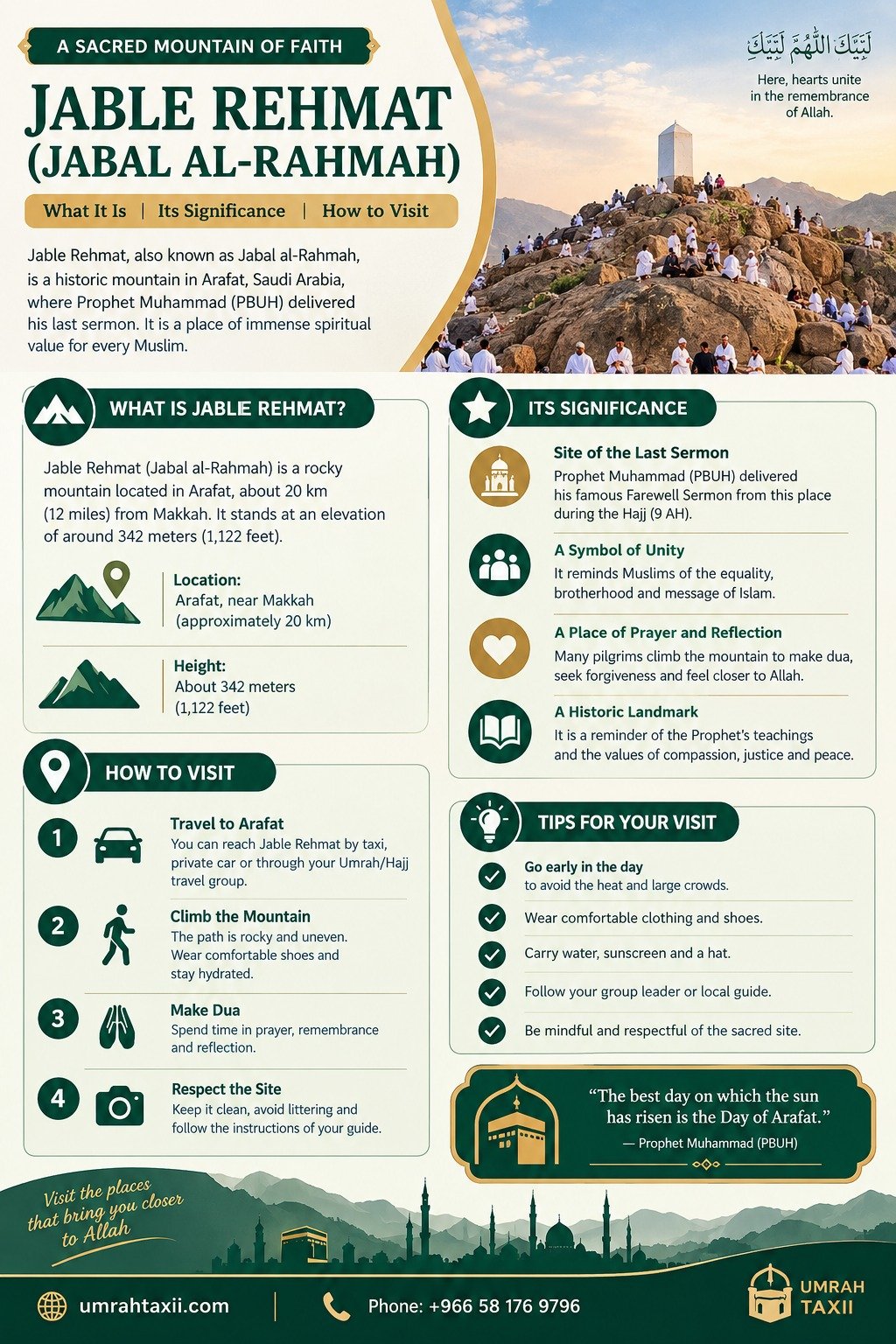
Among all the sacred sites in the holy land of Saudi Arabia, few carry the spiritual weight of Jabal al-Rahmah — the Mountain of Mercy. Rising quietly from the vast plain of Arafat, approximately 22 kilometres southeast of Makkah, this modest granite hill of just 65 metres above the surrounding ground has witnessed some of the most profound moments in Islamic history. For millions of Muslim pilgrims who travel from every corner of the world each year for Hajj, standing near this mountain on the 9th of Dhul Hijjah is an experience that changes lives forever.
Whether you are preparing for your first Hajj, planning an Umrah Ziyarat tour, or simply deepening your knowledge of Islam’s most sacred geography, this complete guide by Umrah Taxii covers everything you need to know about Jable Rehmat — its names, its location, its history, its significance in Islam, what happens there, and how to visit it safely and respectfully.
What is Jabal al-Rahmah? (Jable Rehmat)
Jabal al-Rahmah, also written as Jable Rehmat or Jabal e Rehmat, is a small rocky hill located within the plain of Arafat in Saudi Arabia. Its name in Arabic translates directly as the Mountain of Mercy — and few names in Islamic geography are more fitting.
Physically, the mountain is not particularly tall. It stands approximately 65 metres above the plain of Arafat, with its highest point sitting at 372 metres above sea level. What makes it immediately recognisable to pilgrims is the tall white pillar erected at its summit, which can be seen from across the wide, flat plain and serves as a landmark and meeting point for the millions of pilgrims who gather here during Hajj.
The mountain is composed of large, hard black granite stones typical of the Hijaz region of Saudi Arabia. Its surface at the summit is relatively flat and wide, enclosed by a low protective wall approximately 57 centimetres high. Stone steps on the southern side of the mountain lead pilgrims to the top, making the climb manageable for most visitors under normal conditions.
The mountain goes by several names in Islamic tradition and scholarship, each reflecting a different dimension of its meaning:
- Jabal al-Rahmah — Mountain of Mercy (most widely used)
- Jabal Arafat — Mountain of Arafat
- Jabal al-Dua — Mountain of Supplication
- Jabal al-Tawba — Mountain of Repentance
- Jabal al-Qurain — an older historical name used in classical Arabic sources
Each of these names points to the same spiritual reality: this is a place of turning back to Allah, of seeking forgiveness, and of experiencing His mercy in its most abundant form.
Where is Jabal al-Rahmah Located?
Jabal al-Rahmah is located on the eastern side of the plain of Arafat, approximately 22 kilometres east of Makkah al-Mukarramah. To be more precise about its position relative to other key Hajj sites:
- 22 km from the centre of Makkah
- 10 km from Mina
- 6 km from Muzdalifah
- Located between Makkah and Taif on the main highway
The plain of Arafat itself is a broad, relatively flat expanse of land that stretches across a significant area to the east and southeast of Makkah. During the Hajj season, this entire plain becomes one of the most densely populated places on earth as millions of pilgrims converge on it for the ritual of Wuquf on the 9th of Dhul Hijjah.
It is important to understand the distinction between the mountain and the plain:
- The Plain of Arafat (Arafah) is the large designated area where pilgrims must stand to fulfil the Wuquf obligation. Standing anywhere within its boundaries is sufficient.
- Jabal al-Rahmah is the notable hill and landmark within that area, identified by the white pillar at its peak.
Both terms — Arafat and Jabal al-Rahmah — are often used interchangeably in everyday speech, but understanding the distinction matters for pilgrims who want to ensure their Hajj ritual is correctly performed.
The History of Jabal al-Rahmah
The Meeting of Prophet Adam (AS) and Hawa (AS)
The most widely narrated historical significance of Jabal al-Rahmah relates to the story of Prophet Adam (AS) and Hawa (AS) — Adam and Eve. According to Islamic tradition, after being sent down from Jannah (Paradise) to earth, Prophet Adam and Hawa were separated and spent a period of time apart. It is believed that they were eventually reunited on the plain of Arafat — and specifically near this hill — where their repentance was accepted by Allah (SWT).
This story is the source of the mountain’s most popular name, the Mountain of Mercy, as it marks the place where two of the most beloved of Allah’s creation were shown divine forgiveness after sincere repentance. A white pillar now stands at the summit to mark the spot where this reunion is believed to have taken place.
It is worth noting that Islamic scholars hold different views on the precise nature and location of this event, and it is not mentioned explicitly in the Quran. However, the narration is deeply embedded in Islamic historical tradition and gives the mountain its profound emotional meaning for millions of pilgrims.
Planning to visit Jeddah airport and need comfortable private transportation? Explore our jeddah airport to makkah taxi for convenient transfers and Ziyarat travel.
The Farewell Sermon of Prophet Muhammad (PBUH)
The second — and historically verifiable — significance of Jabal al-Rahmah is its connection to the Farewell Pilgrimage (Hajjat al-Wada) of Prophet Muhammad (PBUH) in 632 CE, the 10th year of the Hijri calendar.
During this pilgrimage, the last of his life, the Prophet Muhammad (PBUH) stood in the plain of Arafat and delivered his historic Farewell Sermon (Khutbat al-Wada). The sermon was addressed to the approximately 100,000 companions who had accompanied him on the pilgrimage and laid down universal principles that continue to guide Muslim life today:
- The sanctity of human life and property
- The abolition of all forms of racial and tribal superiority
- The rights of women and the responsibilities of men toward them
- The importance of holding firmly to the Quran and the Sunnah
- The declaration that all Muslims are brothers
The Prophet (PBUH) concluded the sermon by asking his companions whether he had conveyed the message of Allah, to which they all responded: “Yes.” He then raised his finger to the sky and said: “O Allah, be my witness.”
This moment — delivered within the boundaries of Arafat, in the shadow of Jabal al-Rahmah — is one of the most significant in the entire history of Islam.
The Significance of Jabal al-Rahmah in Islam
“Hajj is Arafat”
The most important statement that explains why Jabal al-Rahmah and the plain of Arafat matter so profoundly is a hadith of the Prophet Muhammad (PBUH):
“Hajj is Arafat.” (Al-Hakim, al-Mustadrak; Tirmidhi)
This short but powerful statement means that standing in Arafat on the 9th of Dhul Hijjah — the Day of Arafah — is the single most essential pillar of the entire Hajj pilgrimage. Without it, the Hajj is not valid. A pilgrim who misses any other ritual can make it up with a fidyah or dam (sacrifice). But a pilgrim who misses Arafat has missed the Hajj entirely and must repeat it the following year.
The Day of Arafah — The Greatest Day of the Year
The 9th of Dhul Hijjah — the Day of Arafah — is considered one of the holiest days in the Islamic calendar. On this day:
- Millions of pilgrims stand in the plain of Arafat from noon (Dhuhr) until sunset, engaged in dhikr, dua, istighfar (seeking forgiveness), and recitation of the Quran
- The Khutbah of Arafah is delivered from Masjid al-Namirah, following the practice of the Prophet (PBUH)
- The combined prayer of Dhuhr and Asr is offered together, as established in authentic hadith
- Pilgrims wear the white Ihram garments symbolising equality, purity, and humility before Allah
The Prophet (PBUH) said about this day:
“There is no day on which Allah frees more people from the Fire than the Day of Arafah. He draws near and then He boasts of them before His angels, saying: ‘What are these people seeking?'” (Sahih Muslim)
For Muslims who are not performing Hajj, fasting on the Day of Arafah is highly recommended. According to a hadith narrated by Abu Qatada (RA), the Prophet (PBUH) said:
“Fasting on the Day of Arafah expiates the sins of the previous year and the coming year.” (Sahih Muslim)
Is Climbing Jabal al-Rahmah Obligatory?
This is one of the most common questions pilgrims ask before visiting, and the answer from Islamic scholars is clear: No, climbing Jabal al-Rahmah is not obligatory for Hajj.
The obligation of Wuquf — standing in Arafat — is fulfilled by being anywhere within the boundaries of the plain of Arafat between noon and sunset on the 9th of Dhul Hijjah. The mountain itself is a landmark and a symbol, not a requirement. Standing at its base, or anywhere else within the Arafat boundaries, is equally valid.
Many pilgrims choose to climb the mountain as a personal act of devotion, to make dua at the summit, and to feel a tangible connection to the history of Islam. This is entirely permissible and spiritually meaningful. However, pilgrims — especially the elderly, those with physical limitations, or those travelling during peak summer heat — should never feel obligated to climb. The Wuquf in the plain itself is what counts.
Umrah Taxi Packages
For pilgrims planning to visit Jabal Al-Rahmah and other important sites around Makkah, Umrah Taxi Packages offer a convenient way to travel comfortably between ziyarat locations.
What Happens at Jabal al-Rahmah During Hajj
On the 9th of Dhul Hijjah, the atmosphere at Jabal al-Rahmah and the surrounding plain of Arafat is unlike anything else on earth. Pilgrims from every nation on earth — speaking different languages, wearing identical white Ihram garments — converge on this one place in a scene that echoes the Day of Judgement.
Here is what the day looks like for a Hajj pilgrim:
Morning: Pilgrims travel from Mina to the plain of Arafat. The journey covers approximately 10 kilometres and is made by bus, on foot, or by private transport arranged through a licensed Hajj transport provider such as Umrah Taxi booking.
Noon (Dhuhr time): The Khutbah of Arafah is delivered at Masjid al-Namirah. Pilgrims then offer the combined Dhuhr and Asr prayers together, shortened to two rakats each.
Afternoon until Sunset: The most important period of the entire Hajj. Pilgrims stand, sit, or remain in the plain engaged in constant worship — making dua, reciting the Quran, performing dhikr, weeping in repentance, and asking Allah for everything they need in this life and the next. Many pilgrims describe this as the most spiritually powerful experience of their lives.
Sunset: As soon as the sun sets, Wuquf ends. Pilgrims immediately begin the journey to Muzdalifah for Maghrib and Isha prayers combination. .
Luxury Bus Umrah Packages.
For families and larger groups visiting Jabal Al-Rahmah, Luxury Bus Umrah Packages provide a comfortable transportation option for group ziyarat and travel between Makkah and other destinations.
How to Visit Jabal al-Rahmah — Practical Guide
During Hajj Season
During Hajj, visiting Jabal al-Rahmah is straightforward because the entire Hajj itinerary revolves around this location. All licensed Hajj groups travel to Arafat on the 9th of Dhul Hijjah as part of their pilgrimage package.
Key practical tips for Hajj visitors:
- Arrive early. The plain of Arafat fills up quickly on the Day of Arafah. Arriving before noon ensures you have time to find a comfortable spot, offer your prayers, and begin your worship without rush.
- Stay hydrated. The Arafat plain is hot, especially during summer Hajj seasons. Carry water at all times and use umbrellas or portable shade where available.
- Do not rush to climb the hill. The crowds on the hill itself can be extremely dense. For elderly pilgrims, those with medical conditions, or families with young children, staying at the base and making dua from the plain is equally valid and far safer.
- Focus on worship, not photography. This is the most important moment of your Hajj. Use the time for sincere dua and istighfar rather than capturing the scene for social media.
- Stay within Arafat boundaries. Ensure you remain within the clearly marked boundaries of Arafat. Leaving the boundaries before sunset invalidates the Wuquf.
During Umrah and Ziyarat Tours
Jabal al-Rahmah is also visited by pilgrims performing Umrah and by Muslims on Ziyarat (Islamic heritage site) tours outside the Hajj season. During these periods, the plain of Arafat is quiet and accessible, offering a very different but deeply contemplative experience.
At Umrah Taxii, we regularly include Jabal al-Rahmah in our Makkah Ziyarat tour itineraries. Visiting outside Hajj season allows pilgrims to:
- Walk the plain of Arafat in relative calm and solitude
- Climb the mountain at their own pace without crowd pressure
- Spend time in personal dua and reflection at the summit
- Understand the physical geography of the Day of Arafah before experiencing it during Hajj
Getting to Jabal al-Rahmah from Makkah: The mountain is approximately 22 kilometres from the centre of Makkah — around 30 to 45 minutes by road depending on traffic. During Hajj, the roads are heavily managed by Saudi authorities with dedicated pilgrim transport corridors. During Umrah season, the journey is straightforward by private vehicle.
Umrah Taxii provides reliable, air-conditioned private transport from Makkah to Jabal al-Rahmah and Arafat for both Hajj and Umrah visitors. Whether you are travelling as an individual, a couple, a family, or a group, we arrange comfortable vehicles with experienced drivers who know the routes to all major Makkah Ziyarat sites. Contact us to add Jabal al-Rahmah to your Makkah Ziyarat itinerary.
What to Do When You Visit Jabal al-Rahmah
Whether visiting during Hajj or Umrah season, here are the recommended acts of worship and etiquette for your visit:
Make sincere dua. The Day of Arafah is described in hadith as the best day for dua. Even outside Hajj season, the plain of Arafat is a place associated with divine mercy and the acceptance of supplication. Stand facing the Qibla and ask Allah for everything — forgiveness, health, family, guidance, and success in both worlds.
Perform dhikr. The best dhikr on the Day of Arafah, according to the Prophet (PBUH), is:
“La ilaha illa Allah, wahdahu la sharika lah, lahul-mulku wa lahul-hamdu, wa huwa ‘ala kulli shay’in qadir.”
(There is no god but Allah, alone, without partner. His is the dominion and His is the praise, and He is over all things capable.)
Reflect on the history. Take a moment to reflect on the significance of where you are standing — the place where Prophet Adam and Hawa were reunited, where Prophet Muhammad (PBUH) delivered his last sermon, and where millions of believers have sought and received Allah’s mercy.
Observe proper adab (etiquette). Avoid loud conversations, arguments, and worldly distractions. Dress modestly. Be patient and considerate of other visitors, especially the elderly and those with physical limitations.
Practical Information for Visiting Jabal al-Rahmah
| Detail | Information |
|---|---|
| Location | Plain of Arafat, 22 km from Makkah |
| Height | 65 metres above the plain, 372 m above sea level |
| Access | Stone steps on southern side |
| Landmark | White pillar at summit, 7 metres tall |
| Best time to visit | During Umrah: any time of year. During Hajj: 9th Dhul Hijjah |
| Distance from Mina | 10 km |
| Distance from Muzdalifah | 6 km |
| Transport from Makkah | 30 to 45 minutes by private vehicle |
| Facilities during Hajj | Tents, water stations, medical services, toilets |
| Climbing obligatory? | No — standing anywhere in Arafat boundaries is sufficient |
Frequently Asked Questions About Jabal al-Rahmah
-
What does Jabal al-Rahmah mean in English?
Jabal al-Rahmah translates as the Mountain of Mercy in English. "Jabal" means mountain in Arabic and "Rahmah" means mercy.
-
Q.Is Jable Rehmat and Jabal al-Rahmah the same place?
Answer,Yes. Jable Rehmat, Jabal e Rehmat, Jabal al-Rahmah, Jabal Arafat and Mount Arafat are all names referring to the same sacred hill in the plain of Arafat near Makkah in Saudi Arabia.
-
Q.Is it compulsory to climb Jabal al-Rahmah during Hajj?
Answer, No. Climbing Jabal al-Rahmah is not a requirement of Hajj. The obligatory act is Wuquf — standing within the boundaries of the plain of Arafat between noon and sunset on the 9th of Dhul Hijjah. The mountain itself is a landmark and symbol, not an obligation.
-
Q.Can you visit Jabal al-Rahmah during Umrah?
Answer,Yes. Jabal al-Rahmah and the plain of Arafat can be visited throughout the year. Many pilgrims on Umrah or Makkah Ziyarat tours visit as part of their Ziyarat itinerary. Umrah Taxii includes Jabal al-Rahmah in our Makkah Ziyarat tours.
-
Q. How far is Jabal al-Rahmah from Makkah?
Answer,Jabal al-Rahmah is approximately 22 kilometres from the centre of Makkah, a journey of 30 to 45 minutes by private vehicle under normal traffic conditions.
-
Q.What is the white pillar on top of Jabal al-Rahmah?
Answer,The white pillar at the summit of Jabal al-Rahmah is 7 metres tall and serves as a visual marker to help pilgrims identify the mountain across the vast plain of Arafat. It also marks the spot traditionally associated with the reunion of Prophet Adam and Hawa.
-
Q.How do I get to Jabal al-Rahmah from Makkah?
Answer,Umrah Taxii provides private, air-conditioned transport from Makkah to Jabal al-Rahmah and all other Makkah Ziyarat sites. Contact us via WhatsApp or phone to arrange your visit.
-
Q.Travel to Jabal al-Rahmah with Umrah Taxii
Answer,At Umrah Taxii, we have been helping pilgrims reach the sacred sites of Makkah and Madinah comfortably and safely for years. We understand that a visit to Jabal al-Rahmah is not just a sightseeing trip — it is a deeply personal spiritual journey, and every detail of your transport experience should reflect that.
Our services for pilgrims visiting Jabal al-Rahmah include:
- Private air-conditioned vehicles — sedans, Toyota Hiace, Coaster, Staria, and large buses for groups
- Experienced, licensed drivers who know all Makkah Ziyarat routes inside out
- Flexible itineraries — combine Jabal al-Rahmah with Masjid al-Namirah, Muzdalifah, Mina, and other Arafat sites in one visit
- 24/7 availability — we operate throughout the Hajj and Umrah seasons without interruption
- Fixed rates, no hidden charges — transparent pricing confirmed before your journey begins
- WhatsApp booking — instant confirmation, fast response