
Masjid Ayesha (Miqat Taneem) Makkah — Complete Ihram Guide, Location, Taxi Fare and Tips 2026
There is a moment every Umrah pilgrim reaches that carries a weight unlike any other in the pilgrimage journey. It is not the first sight of the Kaaba, though that comes shortly after. It is not the opening takbir of Tawaf, though that is extraordinary. It is the moment of putting on the Ihram — those two simple white garments for men, that modest covering for women — and making the intention that strips away every marker of worldly identity and announces, in the simplest possible terms: I am here, O Allah, I am here.
For pilgrims already within the boundaries of Makkah — whether residents, returning pilgrims who want to perform additional Umrahs, or visitors who missed their Miqat — that moment of Ihram begins at one specific place: Masjid Ayesha, in the area of Taneem, approximately 7.5 kilometres from Masjid al-Haram.
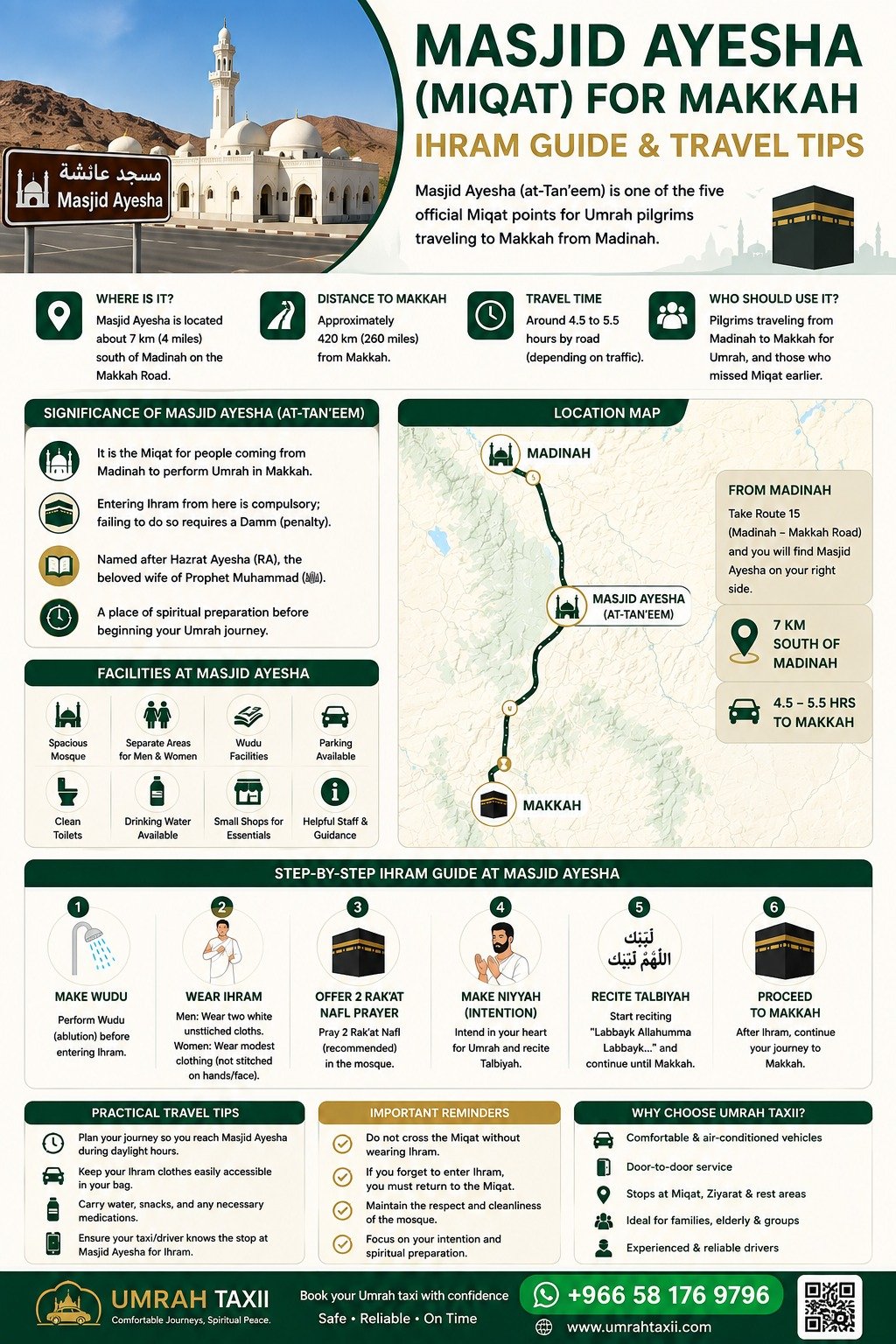
This complete 2026 guide by Umrah Taxii covers everything you need to know about Masjid Ayesha — its history and significance, its exact location, the step-by-step process of entering Ihram there, the facilities available, the taxi fare from central Makkah, and all the practical tips that make the experience smooth, spiritually focused, and exactly what it should be.
What is Masjid Ayesha and Why Does It Matter?
Masjid Ayesha — also widely known as Masjid al-Taneem or Masjid Aisha — is a mosque located in the Taneem area on the northern outskirts of Makkah. It is one of the most essential Miqats (designated stations for Ihram) for pilgrims already inside Makkah.
In simple terms: if you are in Makkah and you want to perform Umrah — whether for the first time, a second time, or any subsequent time during your stay — you cannot simply walk to the Haram and begin Tawaf. You must first travel outside the Haram boundary, enter the state of Ihram with the correct intention, and then return to perform the Umrah rituals. Masjid Aisha is technically outside the Haram boundary. However, it’s still located within the city of Makkah, which is why it is an official Miqat for Umrah.
Masjid Ayesha is the nearest and most accessible Miqat point to Masjid al-Haram, making it the standard choice for:
- Pilgrims staying in Makkah who wish to perform multiple Umrahs
- Makkah residents beginning their Umrah journey
- Pilgrims who arrived in Makkah without entering Ihram and need a local Miqat
- Anyone who has completed one Umrah and wishes to perform another during the same stay
Pilgrims who are staying in Makkah visit the mosque to begin another Umrah by returning to Ihram at the Haram boundary.
The History of Masjid Ayesha — The Story Behind the Name
Masjid Aisha’s history goes back to 240 AH, the year it was first constructed during the Abbasid period. It is where Aisha (RA) was instructed by the Prophet (PBUH) to begin Umrah during the Farewell Hajj.
The story behind the naming of this mosque is one of the most touching and human moments in the entire narrative of the Prophet’s (PBUH) Farewell Pilgrimage in 10 AH (632 CE).
The Story of Sayyidah Aisha (RA) and the Taneem Miqat
Sayyidah Aisha bint Abi Bakr (RA) — the beloved wife of the Prophet Muhammad (PBUH) — had accompanied him on the Farewell Pilgrimage with the intention of performing both Hajj and Umrah together. However, when the pilgrims arrived at Sarif — a location a few kilometres from Makkah — she began her menstrual cycle. The Prophet (PBUH) came to her and she was weeping.
He asked her: “What is the matter with you? Have you started your menses?”
She said: “Yes.”
He said: “This is a thing that Allah has destined for the daughters of Adam. Perform all the rites of Hajj as the pilgrims do, but do not perform Tawaf around the Kaaba until you are purified.” (Sahih al-Bukhari)
Aisha (RA) performed all the Hajj rituals — standing at Arafat, the Rami at Mina, everything — but she could not perform Tawaf or the Sa’i while in her state of ritual impurity. When the Hajj was complete and she had become pure, she performed the obligatory Ghusl and then performed Tawaf and Sa’i — completing her Hajj.
But she was heartbroken. Every other pilgrim had performed both Hajj and Umrah together, as Qiran or Tamattu. She had missed her Umrah. She said to her brother, Abd al-Rahman ibn Abi Bakr (RA): “I have not performed Umrah.” She was deeply distressed.
The Prophet (PBUH) — understanding her grief — instructed Abd al-Rahman to take her to Taneem so that she could enter Ihram from there and perform her Umrah. Abd al-Rahman took her to Taneem, she entered Ihram, and performed her Umrah. She returned joyful.
The Prophet (PBUH) waited for her at the top of the valley at Al-Abtah, having stayed specifically so she could complete her Umrah before they departed from Makkah.
This story — of a Prophet who waited in the valley for his wife to complete her Umrah, who understood her grief and arranged the solution himself — is one of the most beautiful demonstrations of the Prophet’s (PBUH) character and his care for Aisha (RA). And it is why the mosque at Taneem carries her name.
The Mosque Through History
The original mosque at Taneem was built during the Abbasid period in 240 AH, marking the exact location where Aisha (RA) entered Ihram. Over the centuries it was renovated, expanded, and rebuilt multiple times. The current structure is a modern, spacious mosque capable of accommodating thousands of pilgrims simultaneously, with full facilities for Ghusl, changing, and prayer — while maintaining its function as the Miqat point it has been since the time of the Prophet (PBUH).
Where is Masjid Ayesha Located?
Masjid Ayesha is situated in the Al-Tan’im neighbourhood of Makkah, along the main road that connects the city to Madinah. Its proximity to central Makkah makes it the most convenient Miqat for many pilgrims in and around the Haram.
Key location details:
| Detail | Information |
|---|---|
| Official name | Masjid al-Taneem |
| Common names | Masjid Ayesha, Masjid Aisha, Taneem Mosque |
| Neighbourhood | Al-Taneem, Makkah |
| Distance from Masjid al-Haram | Approximately 7.5 to 8 kilometres |
| Distance from Kaaba | Approximately 7 to 8 kilometres |
| Travel time from Haram | 15 to 30 minutes by car depending on traffic |
| Direction from Haram | North, on the road toward Madinah |
| GPS coordinates | 21.4487° N, 39.8284° E |
From the Kaaba: approximately 8 km, about 20 to 25 minutes by car. From most Makkah hotels: approximately 10 km, roughly 25 to 30 minutes. Plan for an extra 10 minutes during prayer times.
The mosque is easily identifiable on all maps of Makkah and is well-signposted from the central Haram area. It sits on the main Makkah-Madinah road — the same road that pilgrims travelling by land from Madinah to Makkah use, though for this purpose they would use the major Miqat points further from Makkah rather than Masjid Ayesha.
Who Should Use Masjid Ayesha as Their Miqat?
Not every pilgrim uses Masjid Ayesha as their Miqat. Understanding who it is designed for prevents confusion and ensures you use the correct Miqat for your situation.
Masjid Ayesha is the Correct Miqat for:
1. Pilgrims already residing in Makkah who wish to perform Umrah
Anyone who is already inside the boundaries of Makkah — whether a resident, a long-term visitor, or a pilgrim staying in the city — must go outside the Haram boundary before entering Ihram for Umrah. Masjid Ayesha is the nearest and most convenient point for this purpose.
2. Pilgrims who have completed one Umrah and wish to perform another
This is the most common reason pilgrims visit Masjid Ayesha. After completing the first Umrah — Tawaf, Sa’i, and shaving or trimming the hair — a pilgrim who wishes to perform a second Umrah must exit the Haram boundary, re-enter Ihram with a new intention, and return for a new Tawaf and Sa’i. Masjid Ayesha is the standard departure point for this purpose.
3. Pilgrims who arrived in Makkah without entering Ihram and missed their Miqat
Occasionally, pilgrims who should have entered Ihram at one of the five major Miqat points (Dhul Hulayfah, Al-Juhfah, Qarn al-Manazil, Yalamlam, or Dhat Irq) failed to do so — perhaps due to arriving by air and missing the announcement on the aircraft, or due to misunderstanding. Such pilgrims typically must either pay a fidyah (penalty) or return to their applicable Miqat. However, in some scholarly opinions, using Masjid Ayesha as a substitute Miqat may be discussed with a knowledgeable scholar.
4. Makkah residents beginning any Umrah journey
People who live in Makkah permanently are in a special category — their Miqat is always the nearest boundary of the Haram, meaning they must go outside it to enter Ihram. Masjid Ayesha serves this purpose perfectly.
Masjid Ayesha is NOT the Miqat for:
Pilgrims arriving from outside Saudi Arabia who have not yet entered Makkah should use the major Miqat points appropriate to their direction of travel — not Masjid Ayesha. Masjid Ayesha is the most significant and accessible Miqat location specifically for pilgrims staying in Makkah or those traveling from nearby cities like Jeddah and Abha.
Step-by-Step: How to Perform Ihram at Masjid Ayesha
This is the complete process for entering the state of Ihram for Umrah at Masjid Ayesha in 2026.
Before You Leave Your Hotel
Step 1 — Perform Ghusl (ritual purification bath)
Before travelling to Masjid Ayesha, perform a complete Ghusl at your hotel. This is a Sunnah Mu’akkadah — a strongly emphasized practice — before entering Ihram. Our comprehensive guide to performing Ghusl for Umrah covers this in full detail. Perform the Ghusl with proper intention, ensuring every part of the body is washed correctly.
Step 2 — Trim nails and remove unwanted body hair
These acts must be done before entering Ihram — they are prohibited in the state of Ihram. Do them at the hotel before departure. You have to prepare yourself mentally and physically before you reach Masjid Ayesha to approach the state of Ihram. This involves performing Ghusl (ritual purification), trimming your nails and cutting your hair (for men), and being sure that you are clean.
Step 3 — Apply perfume (before Ihram, not after)
If you wish to apply fragrance, do so before putting on the Ihram garments — to your body, not the Ihram cloth itself. Fragrance is prohibited once Ihram is worn.
Step 4 — Prepare your Ihram garments
For men: two white unstitched pieces of cloth. For women: their chosen modest, covering clothing (not specific white garments — women may wear any colour as long as it is modest and covering). Have your Ihram ready to wear at the mosque or before departure.
Step 5 — Book your transport with Umrah Taxii
Contact Umrah Taxii on WhatsApp to arrange your private transfer from your hotel to Masjid Ayesha and back. Having a reliable, waiting vehicle means you can focus entirely on the spiritual preparation rather than worrying about transport.
At Masjid Ayesha
Step 6 — Use the mosque facilities
The place is well-equipped with bathing facilities and washrooms for the pilgrims to use and there are vendors outside the mosque sending Ihram clothes and other essential items that the pilgrims might need. Elitetravelsandtours
The mosque has extensive, well-maintained washing and changing facilities for both men and women, with separate entrances and areas. If you have not yet performed Ghusl or wish to freshen up after the car journey, you can do so here.
Step 7 — Put on your Ihram garments
Change into your Ihram at the mosque’s changing facilities. Men wear the two white unstitched cloths correctly — the lower garment (izar) around the waist and the upper garment (rida) over the upper body, leaving the right shoulder bare for Tawaf. Women dress modestly in their chosen Ihram clothing with full hijab.
Step 8 — Offer two rakats of nafl prayer (if not at a prohibited time)
Before making your intention, offer two rakats of nafl (voluntary) prayer in the mosque with the intention of Ihram prayer — a Sunnah before entering the state of Ihram. This prayer may not be offered during the three prohibited times (sunrise, midday, sunset). If you arrive at one of these times, proceed directly to the intention without the prayer.
Step 9 — Make the Niyyah (Intention)
This is the pivotal moment. After prayer, make your intention for Umrah verbally and in your heart. The words of the intention are:
لَبَّيْكَ اللَّهُمَّ عُمْرَةً
Labbayka Allahumma ‘Umratan
“O Allah, here I am for Umrah”
Or in a longer, more comprehensive form:
اللَّهُمَّ إِنِّي أُرِيدُ الْعُمْرَةَ فَيَسِّرْهَا لِي وَتَقَبَّلْهَا مِنِّي
Allahumma inni uridu al-‘Umrata fayassirha li wa taqabbalha minni
“O Allah, I intend to perform Umrah, so make it easy for me and accept it from me”
Step 10 — Begin reciting the Talbiyah
Immediately upon making the intention, begin reciting the Talbiyah — the call of the pilgrim — continuously until you begin your Tawaf:
لَبَّيْكَ اللَّهُمَّ لَبَّيْكَ، لَبَّيْكَ لَا شَرِيكَ لَكَ لَبَّيْكَ، إِنَّ الْحَمْدَ وَالنِّعْمَةَ لَكَ وَالْمُلْكَ، لَا شَرِيكَ لَكَ
Labbayka Allahumma labbayk, labbayka la sharika laka labbayk, innal hamda wa ni’mata laka wal mulk, la sharika lak
“Here I am, O Allah, here I am. Here I am, You have no partner, here I am. Verily all praise and blessings are Yours, and all sovereignty. You have no partner.”
Men recite the Talbiyah loudly. Women recite it softly, audible only to themselves.
Step 11 — Proceed to Masjid al-Haram
Return to your waiting Umrah Taxii vehicle and travel directly to Masjid al-Haram to begin your Umrah. Continue reciting Talbiyah throughout the journey. The Talbiyah continues until you begin your first circuit of Tawaf.
The Ihram Prohibitions — What Becomes Forbidden After Intention
Once you have made the Niyyah at Masjid Ayesha and are in the state of Ihram, certain actions become prohibited until you complete your Umrah and exit Ihram:
For men:
- Covering the head (wearing a hat, cap, or hood)
- Wearing stitched garments
- Using perfume or scented products
- Cutting or shaving hair anywhere on the body
- Cutting fingernails or toenails
- Sexual relations or intimate physical contact
- Hunting land animals or participating in hunting
- Marriage contracts (conducting a Nikah)
For women:
- Wearing face veil (niqab) or gloves — the face and hands must remain uncovered
- Using perfume
- Cutting hair
- Sexual relations or intimate physical contact
- All other prohibitions that apply to men except head covering and stitched garments
Important: Women in a state of menstruation may still put on Ihram and make the intention at Masjid Ayesha. They perform all Umrah rituals except Tawaf and Sa’i, which they perform after becoming pure.
Facilities at Masjid Ayesha
Masjid Ayesha is equipped to handle thousands of pilgrims daily with modern facilities. Spacious bathrooms: separate large areas for men and women.
The mosque has been developed to serve the enormous number of pilgrims who use it daily — particularly during Ramadan and Hajj season when the volume can reach 50,000 or more pilgrims in a single day.
Available facilities:
Ablution and Ghusl areas: Large, well-maintained washing facilities with showers for Ghusl, separate for men and women. These are clean, modern, and well-supplied with running water.
Changing rooms: Dedicated changing areas for pilgrims to put on Ihram garments in privacy and comfort, separate for men and women.
Prayer halls: A large, air-conditioned main prayer hall with separate sections for men and women. The prayer hall is spacious enough to accommodate large crowds without feeling overcrowded outside of peak Ramadan periods.
Zamzam water stations: Zamzam water is available within the mosque complex for pilgrims to drink before beginning their Umrah journey.
Ihram garment vendors: There are vendors outside the mosque sending Ihram clothes and other essential items that the pilgrims might need. If you have not brought your Ihram with you or need to replace a garment, vendors outside the mosque sell everything required at reasonable prices. Elitetravelsandtours
Restrooms: Well-maintained toilet facilities throughout the complex, kept clean by regular maintenance staff.
Parking: The mosque has parking areas for private vehicles. Umrah Taxii drivers are familiar with the best parking and waiting areas to minimise the time between your return from the mosque and beginning your journey to the Haram.
Taxi Fare from Makkah Hotels to Masjid Ayesha 2026
The taxi cost between Masjid al-Haram and Masjid Ayesha generally ranges between 60 and 100 SAR for a round trip, depending on demand. Peak seasons, such as the Hajj, can increase the cost.
Here is the complete fare guide for transport between Masjid al-Haram area hotels and Masjid Ayesha in 2026:
| Journey | Standard Fare | Peak Season Fare |
|---|---|---|
| Hotel to Masjid Ayesha (one way) | SAR 40 to SAR 60 | SAR 60 to SAR 100 |
| Round trip (hotel → Ayesha → Haram) | SAR 60 to SAR 100 | SAR 100 to SAR 150 |
| Waiting service at mosque (30-45 min) | Included with Umrah Taxii | Included with Umrah Taxii |
| Night transfer (midnight to Fajr) | SAR 80 to SAR 120 | SAR 100 to SAR 150 |
Why pre-book with Umrah Taxii rather than taking a street taxi:
Unbooked street taxis near the Haram during peak Ramadan and Hajj periods often charge far above these rates — particularly late at night when demand is highest and supply is limited. During the last ten days of Ramadan, pilgrims who want to perform multiple Umrahs each night find that securing a reliable, reasonably-priced taxi can be more challenging than the Umrah itself.
Umrah Taxii offers:
- Fixed fares agreed before departure — no negotiation, no surprises
- Waiting service at Masjid Ayesha while you perform Ghusl, change, and pray
- Direct return to the Haram gate closest to your hotel
- 24/7 availability — including 2 AM and 4 AM trips for the last ten nights of Ramadan
- Instant WhatsApp booking
Travel Time from Makkah to Masjid Ayesha
The distance between Masjid e Ayesha and Masjid al-Haram is around 7.5 to 8 km. Depending on the traffic, it takes 15 to 30 minutes to drive.
| Time of Day | Typical Travel Time |
|---|---|
| Early morning (Fajr to 8 AM) | 10 to 15 minutes |
| Morning (8 AM to 12 PM) | 15 to 25 minutes |
| Afternoon (12 PM to 5 PM) | 20 to 30 minutes |
| Evening (after Maghrib) | 25 to 40 minutes |
| Late night during Ramadan | 30 to 60 minutes |
The road from central Makkah to Taneem passes through several busy intersections, and traffic around the Haram area — particularly on the approach roads — can become heavily congested during prayer times and after Tarawih prayers during Ramadan. Umrah Taxii drivers are experienced with Makkah’s traffic patterns and know the best routes and timing to minimise delays.
Best Time to Visit Masjid Ayesha for Ihram
For Multiple Umrahs During Ramadan
The last ten nights of Ramadan — the period during which Laylat al-Qadr (the Night of Power) falls — see the most intense demand for Masjid Ayesha transport, as thousands of pilgrims wish to perform an Umrah on every single night, particularly on the odd nights (21st, 23rd, 25th, 27th, and 29th of Ramadan). The Prophet (PBUH) said: “Whoever performs Umrah in Ramadan, it is equivalent to performing Hajj with me.” (Sahih al-Bukhari, Sahih Muslim)
For these nights, the best approach is to travel to Masjid Ayesha immediately after Isha and Tarawih prayers — around midnight — which allows you to perform your Ghusl, enter Ihram, complete your Umrah, and return in time for Suhoor.
On busy Umrah days, you might see 50,000 or more pilgrims at Taneem. Shared shuttles often leave once complete, so booking a private seat guarantees you won’t be left behind.
Pre-booking with Umrah Taxii for specific nights during Ramadan — particularly the last ten nights — is strongly recommended. Our vehicles are reserved in advance and guaranteed regardless of demand.
Conclusion
Masjid Ayesha stands at a remarkable intersection of Islamic history and living pilgrimage practice. It was built in memory of a moment of human tenderness — a Prophet caring for his wife’s grief and arranging for her to complete her Umrah — and it continues to serve millions of pilgrims every year who come to this spot to do exactly what she did: enter Ihram with sincere intention and begin the journey toward the Kaaba.
Standing at Masjid Ayesha, putting on your Ihram, and making your intention — knowing that Aisha (RA) stood at this very spot 1,400 years ago and did the same — is one of those moments of living connection to Islamic history that no book can fully convey. You have to be there.
Umrah Taxii will take you there — and bring you back to the Haram to begin — reliably, comfortably, and with the understanding that this journey is not just transport. It is part of your worship.
WhatsApp Umrah Taxii now to book your Masjid Ayesha transfer.